Interview with Matthias Winter, Segment Manager, on key focus areas in the automotive sector
The technological transformation driven by electrification and autonomous driving is creating new demands in the automotive segment. In this interview, Matthias Winter, Head of Market Segment Management at MAPAL, explains MAPAL’s key focus areas in this field.
What is MAPAL’s strategy in the automotive industry?
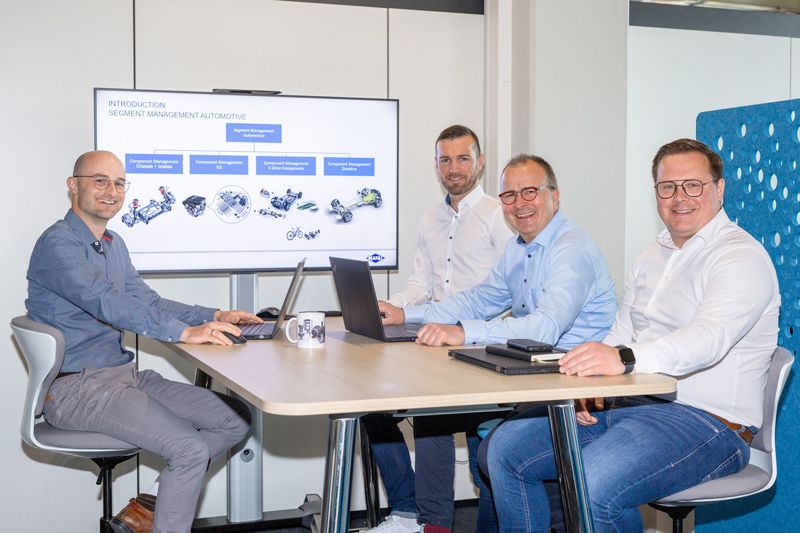
Automotive manufacturing has been our core business for many years and it will stay that way. Alongside aerospace and general machining, automotive is our biggest primary segment. We have structured this segment in four component divisions, which we keep a close eye on. They are each led by their own Component Manager. These divisions are chassis and brakes, combustion engines, e-mobility with electric motor, battery and attachments for thermal management. The fourth division, driveline, includes everything from the coupling to the wheel, i.e. gearbox, differential housing and constant-velocity joints as well. While large automatic gearboxes are essential in combustion engine vehicles, battery-powered electric vehicles do not need them. Instead, they rely on constant-velocity joints, for example. The common thread that runs through our strategic assessments comprises the market, components and solutions. Based on the market, we recognise driving factors and understand key players.
Vehicle production volumes are predicted to grow between now and 2030. However, this growth mainly comes from electric vehicles. A decline is expected for combustion engines, at a higher rate for diesel than petrol. Right now, the momentum towards electrified mobility has certainly slowed, but this transformation will continue to make ground. As 60% less machining is required for a battery-powered electric vehicle, this isn’t a positive development for us to start with. When drawing up strategy, we therefore can’t rely on the combustion engine continuing to carry us. But this will be an ongoing process over the coming years with a pace that varies depending on the region, so we can adapt and respond accordingly. We’re on the right track here.
New technologies also give us the opportunity to launch our own solutions on the market. To experience market trends up close, there is a strong alliance between our segment management and sales. It has eyes and ears on the market and gets information on new developments in components and any changes in production processes from customers. This allows us to constantly tailor our range of solutions to changing requirements.
Generally speaking, how do you define components that are of interest to MAPAL?
We take a very structured approach here and also have a data structure on the component level in our systems in the background. This helps us identify focus components that appeal to us. As a rule, they are of course components with a large machining component, for which a high level of accuracy is required. This means a large market volume cannot be the only criterion: After all, for instance, the market requires many gears. But as we don’t have any serration tools in the portfolio, gears aren’t a thing for us. It’s different for cylinder heads. Large quantities of these are also required. They have challenging bores and require a high level of accuracy. We have very good tool technology to serve these requirements. The same goes for housings for electric motors, that also require a high level of precision. If we can supply or develop competitive products for this with our product and service portfolio, we’re on it. Our product management then develops the right solutions together with R&D.
With the transformation of the automotive industry, are new components also likely to come into play?
Yes, of course. Think of the stator housing for electric vehicles, first of all. This isn’t a brand-new component any more, but there was still a great deal of variance here until recently. The geometry has now stabilised. And there are still always new developments, such as cast-in steel bushings that hold bearings. Machining solutions are certainly a challenge. If we look at the exploded view of an electric motor, we can see even more components that may be of interest to us. In addition to the stator housing, there’s the gearbox housing, bearing cover, and housing for the power electronics.
Self-driving with by-wire technologies is leading to new components in the area of chassis and brakes. Here, we’ve developed machining solutions for a combined brake housing that is required in systems with no hydraulic lines. In their basic functions, the new components are similar to the previous ones, but they introduce more sensor and actuator technology into the vehicles. What matters to us is how this changes parts that are also subject to mechanical processing. Irrespective of individual components, the trend continues towards aluminium, which offsets the additional weight of batteries through more lightweight construction, for example.
How do you implement further developments of components? The solutions portfolio you described for a component is tied to a specific component design, isn’t it?
If requirements change, we of course adapt our range of solutions accordingly. To understand requirements and features of important focus components, we like working with sample components, which we call generic components. After all, no client wants to be a guinea pig for tool developments. That’s why we use our own components here, which demonstrate the real functions as required by industry as clearly as possible. We use generic components like these for electric motors, for instance. Of course, a component’s core characteristics may change with time. These may include additional machining steps, higher accuracy or other materials. That’s where we need to step in where required and modify our sample component, whose design isn’t set in stone. For instance, a lot has happened with valve guides in the past 20 years, in terms of both size and materials. We had to keep launching new test series to continue developing our technology.
The quantities requested may also require changes. The design of a component does not change with the quantity to be produced, but in combination with process requirements, quantities do play a role. This brings us to other tool regions with performance or expert solutions, where more complex tools boost productivity and process capability. These machining solutions for strategic components, which are standardised up to a certain point, are available worldwide through our sales department, by the way. Their significance increases as the shift from local or regional production to global production intensifies. To serve our customers as best we can, we are pushing forward with our global footprint in this area.
In this case, it has nothing to do with carbon. It describes our international setup and how we are able to swiftly assist our customers everywhere with our solutions. In addition to tool manufacture, these include the production of upstream processes, but also after-sales services in particular. For instance, if we deliver PCD tools from Germany to Mexico for an initial projection, almost no one wants to send them back for repair or regrind. It has to be possible there. Recent years have shown how fragile supply chains can be. Our customers view this more critically in their risk management than before, where everything was always trending towards globalisation.
How have supply chains changed?
At MAPAL, we run an ongoing supply chain analysis to identify production relocations. We observe these developments in order to respond to them at an early stage and set up appropriate support on the ground. We are also seeing increased outsourcing of production from automobile manufacturers to suppliers. I sometimes get the impression that the major OEMs want less and less to do with mechanics and prefer to dedicate themselves to the software defined vehicle. But with all software there is luckily still all kinds of hardware. We are the optimum technology partner for machining with our expertise in the market, components, solutions and our extensive product portfolio.