19.06.2023
Tiefe Bohrungen mit PKD optimiert
Als die Schlote Gruppe 2017 ein neues Werk in Harzgerode baute, war die Produktion von Beginn an auf die Serienfertigung eines einzigen Bauteils ausgerichtet. Alle Zerspanungswerkzeuge dafür liefert MAPAL. Optimierungen der Werkzeuge haben die Grundlage dafür geschaffen, nun mit neuen Produkten einen Schritt in die Zukunft zu gehen.
Die Geschichte von Schlote begann 1969 mit einer kleinen Werkstattfertigung in Harsum, wo das Unternehmen immer noch seinen Stammsitz hat. Zur Gruppe gehören heute elf Unternehmen mit insgesamt 1.800 Mitarbeitern. Der Automobilzulieferer verfügt über acht Werke in Deutschland, weitere Produktionsstätten befinden sich in Tschechien und China. Kunden der Schlote Gruppe sind große Automobilhersteller, Systemintegratoren und Gießereien. 55 Prozent seines Umsatzes macht Schlote mit Teilen für Motoren, 39 Prozent entfallen auf Getriebe, sechs Prozent auf Chassis.
Mit der Firma Trimet Aluminium gab es an anderen Standorten bereits eine erfolgreiche Zusammenarbeit, um aus gegossenen Rohlingen einbaufertige Automobilteile herzustellen. Der Zuschlag eines großen Automobilzulieferers für ein Bauteil, das in sehr hohen Stückzahlen gefertigt werden sollte, führte zu einem Joint-Venture zwischen Schlote und Bohai Trimet in Harzgerode.
Mehr als 4.000 Kupplungsgehäuse pro Tag
Bei dem in Harzgerode hergestellten Bauteil handelt es sich um ein Kupplungsgehäuse aus Aluminiumdruckguss. Die Automatikgetriebe des Zulieferers gehen in einer einheitlichen Version an mehrere große Automobilhersteller, bei denen sie vorwiegend in Fahrzeugen bis zu einem Hubraum von zwei Litern eingebaut werden. Die Kupplungsglocke verbindet Getriebe und Motor. Die Getriebeseite ist bei allen Kupplungsgehäusen gleich, die andere Seite ist an die jeweiligen Motoren der Automobilhersteller angepasst. Die Unterschiede sind eher klein, weshalb diese Kupplungsglocke zu 99 Prozent baugleich für alle belieferten Automobilhersteller ist.
Aktuell fertigt die Schlote Harzgerode GmbH davon 4.000 Stück pro Tag. Das moderne Werk verfügt über einen sehr hohen Automatisierungsgrad von über 80 Prozent. Am Standort Harzgerode sind 120 Mitarbeiter beschäftigt, die an fünf Tagen pro Woche rund um die Uhr arbeiten. Bei Bedarf kann die Produktion auch auf sechs oder sieben Tage ausgeweitet werden.
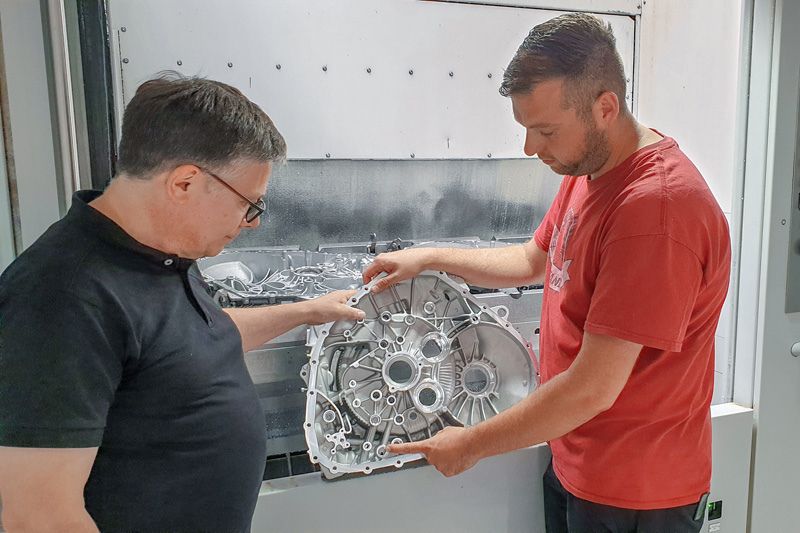
As is the case for the entire automotive industry, the requirements placed on parts are very high here. “The part is not only an adapter flange, but also the back of the transmission. The bearing seats thus require the highest degree of precision”, explains Sebastian Swiniarski, Work Preparation Team Lead at Schlote. The part requires many bores with different tolerances, whereby precision manufacturing is needed down to the thousandth of a millimetre.
MAPAL and Schlote can look back on many years of effective cooperation. MAPAL is therefore entrusted with supplying PCD milling cutters (which create the defined rough surfaces on which sealant is applied), tap drills, reamers and an array of diverse drilling tools. “We offer our customers comprehensive solutions including the development of entire processes”, says Stefan Frick, MAPAL’s technical advisor to Schlote.
Erfolgreicher Verbesserungsprozess
Die eingesetzten Werkzeuge standen von Beginn an auf dem Prüfstand. Seit die Produktion in Harzgerode läuft, werden laufend Analysen betrieben, um mögliche Schwachstellen aufzudecken und die Fertigung zu optimieren. Im Rahmen dieses kontinuierlichen Verbesserungsprozesses ist es in enger Zusammenarbeit zwischen Schlote und MAPAL im Laufe der Jahre gelungen, höhere Standzeiten zu generieren, Werkzeugkosten zu senken und die Produktionsmenge zu steigern. Konnten anfänglich maximal 3.600 Teile pro Tag gefertigt werden, liegt das mögliche Limit heute bei 4.500 Bauteilen, ohne dass zusätzliche Maschinen angeschafft werden mussten.
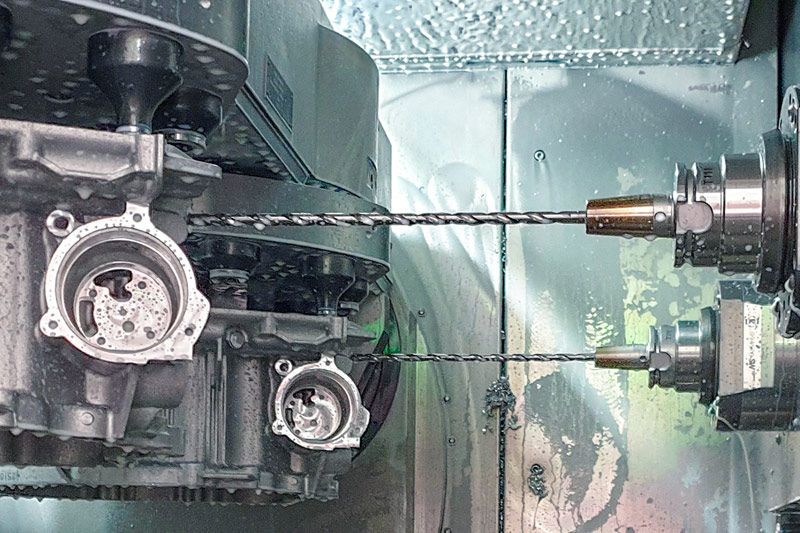
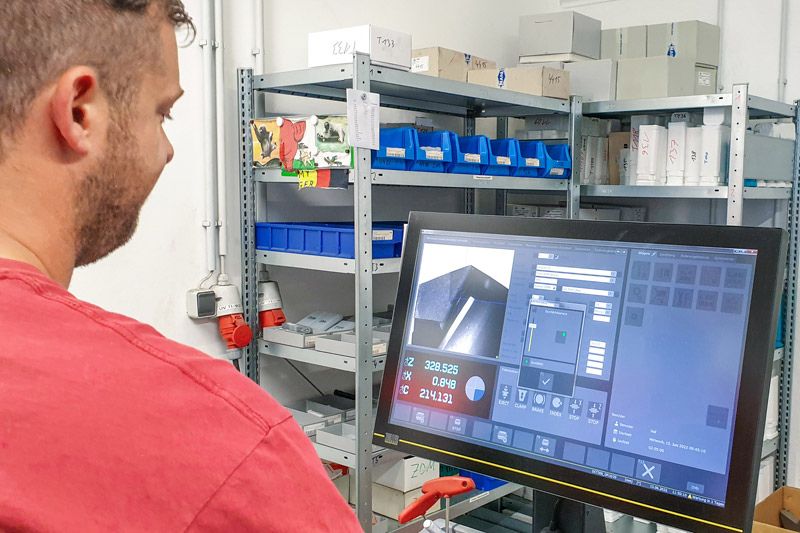
Die jüngste Optimierung betrifft Tiefbohrungen für Ölkanäle, über die im Automatikgetriebe geschaltet wird. „Über unser Toolmanagement-System werten wir monatlich aus, welche Werkzeuge wie oft gewechselt wurden“, berichtet Sebastian Swiniarski. „Dabei haben sich die Tiefbohrer jedes Mal als auffällig erwiesen. Da diese Bohrer auch relativ kostenintensiv sind, haben wir an dem Punkt angesetzt, um unsere Werkzeugkosten weiter zu senken.“ Mit dem Werkzeugverschleiß kommen auch Qualitätsaspekte ins Spiel, da ein stumpfer Bohrer beim Austritt Grate erzeugt.
Erheblicher Standzeitgewinn mit PKD
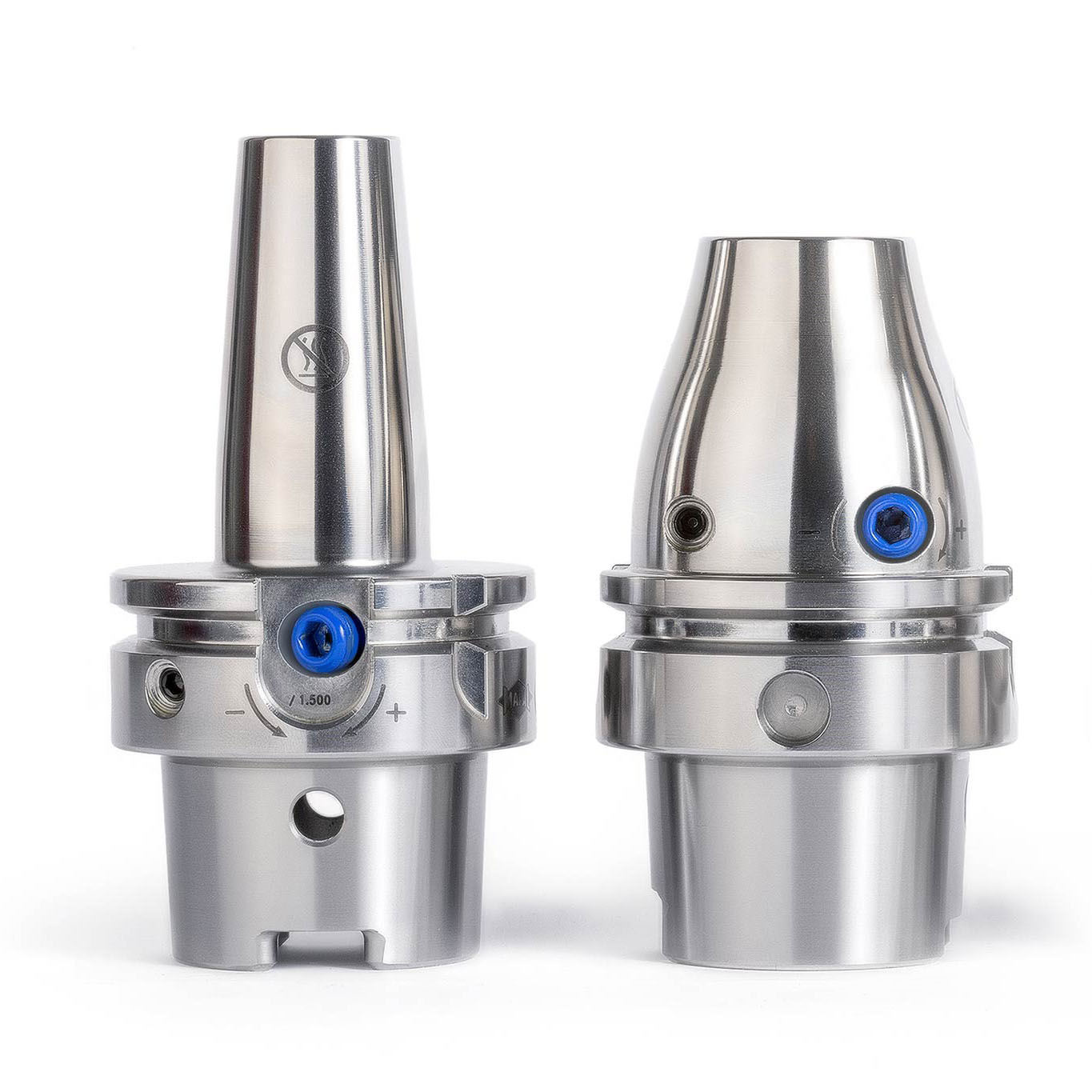
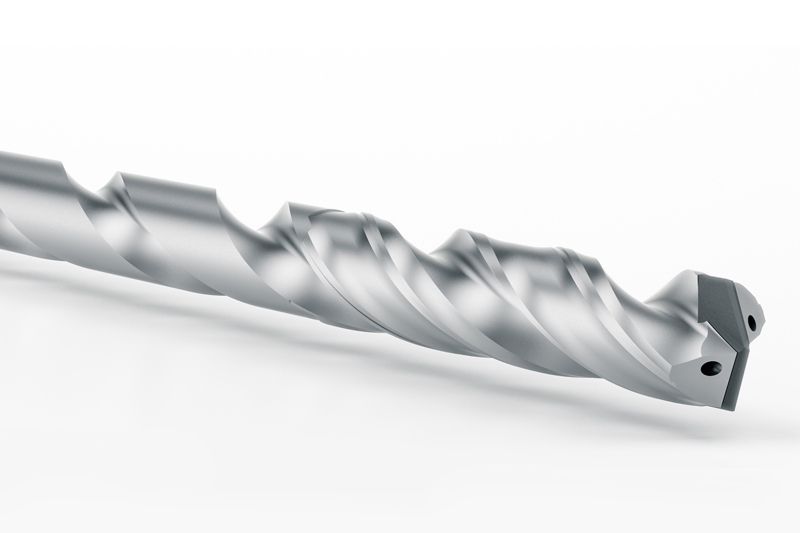
For the new tool, MAPAL started with the existing solid carbide drill and inserted a PCD cutting edge at its tip. The structure of the tool is reminiscent of a concrete drill with a carbide tip. The manufacturers in Harzgerode are very happy with the PCD deep drill’s tool life. While the solid carbide drill’s tool life ends after 2,500 parts, the PCD version keeps going reliably up to 15,000 parts. There is further scope for improvement in machining challenges, such as blowholes in the material and varying casting quality. The partners are currently working on this together. “We have occasionally been able to achieve a tool life of 40,000 parts. Naturally, we want to make this ultra-long tool life the norm”, Frick stresses.
The cutting data is the same as that of the solid carbide drill at a spindle speed of 8,700 rpm, a feed of 0.3 mm/rev and a cutting speed of 218 m/min. The new drill’s potential lays in its considerably longer tool life, the resulting lower tool costs and the higher process reliability. Less tool changes also means less machine downtime.
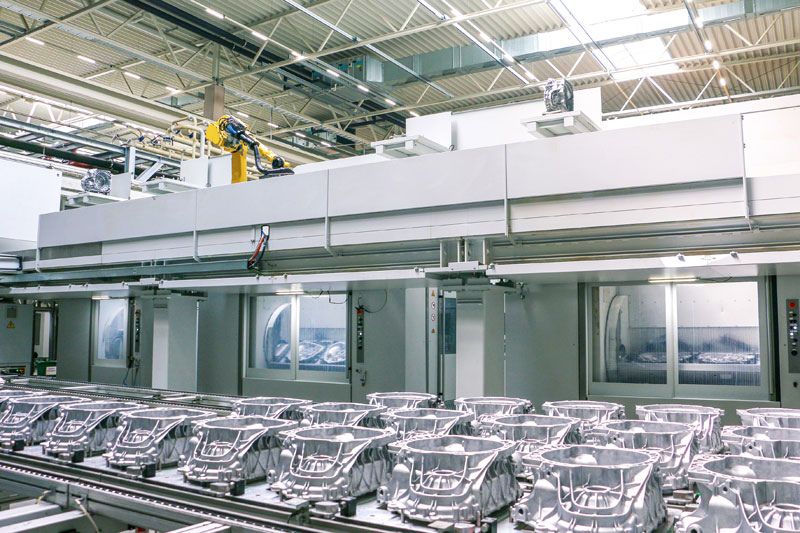
Production at Schlote in Harzgerode involves a total of ten manufacturing cells. Each cell is made up of three machines from the manufacturer SW, two W06 double-spindle machines and a one6 single-spindle machine. The parts are machined in three clamping setups, whereby the double-spindle machines handle the first two setups and finishing takes place during the third.
The future is electric
Clutch housing manufacturing at the site was planned to last at least eight years with a peak output of 1.1 million parts per year. This peak was surpassed in 2020. Production has been ongoing for five years in the meanwhile with 900,000 parts produced per year.
Due to continuously improved productivity and the lower production quantities, there has been time to address future trends and produce different parts. The factory is already being modified for this purpose. The first of two new projects involves six different parts that Schlote is to produce for a hybrid model of super sports car manufacturer.
In the other project, Schlote’s expertise as a clutch housing manufacturer is once again called for – this time for an electric car. Schlote draws from the trend toward electric mobility by supplying e-cars with transmissions as well. For an innovative model with three gears, the connection between engine and transmission is to be produced in Harzgerode. Half of the factory capacity is currently being converted. The production of parts for combustion engines is to be ramped down to 50 per cent. In future, hybrid cars will account for 10 per cent and purely electric mobility for 40 per cent. Schlote has already produced the first parts for the new projects.

Contact
Kathrin Rehor Public Relations Kathrin.Rehor@mapal.com Phone: +49 7361 585 3342