15.10.2025
Maximum impact with minimal effort – paths to greater productivity
MAPAL presents successful solutions on the market
MAPAL has developed standard processes for the industrial production of strategic components. On that basis, these tool solutions are modified according to requirements, to help customers boost their productivity. Success stories from various market segments show just how well this works.
Adapted solutions for hydraulics
Three cutting edges for high feed rates
Enhancing productivity with existing machinery
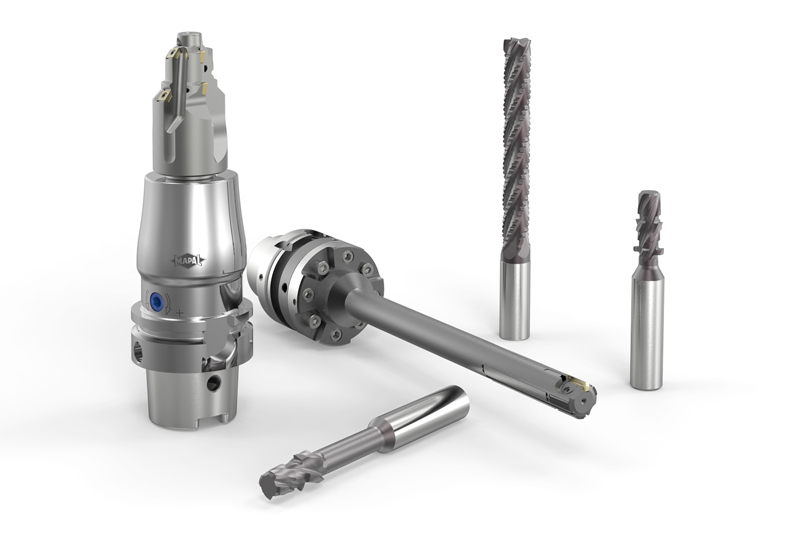
Adapting the process to the existing machine set-up was the focus of another hydraulics project, which also involved spool bores. In this case, the customer often faced large production volumes, making a highest-possible productivity essential for efficient manufacturing. Investment in new machinery was out of the question, however, due to the volatile economic situation. For MAPAL, the challenge therefore lay in achieving a gain in productivity on the existing machine. The aim was a secure process with a reduced cycle time.
The model process could not be applied directly, because it requires the use of a special solid carbide drill for pre-machining in the machining step that follows countersinking. However, the machine did not have sufficient capacity for this drill. Accordingly, MAPAL replaced the drilling specified in the model process with circular milling, which requires less torque. Two additional tools are then used for circular milling of the control edges in the spool bore. MAPAL’s guide pad technology is used for finishing, ensuring the best circularity and surface quality. Instead of the seven tools that the customer was using in their previous process, production is now carried out with just five. This allowed cycle time to be reduced by 40 %, resulting in savings of 1,250 working hours for an annual manufacturing quantity of 30,000 components. Costs were reduced accordingly: The customer saves EUR 14,000 every year.
Higher output for electric motors
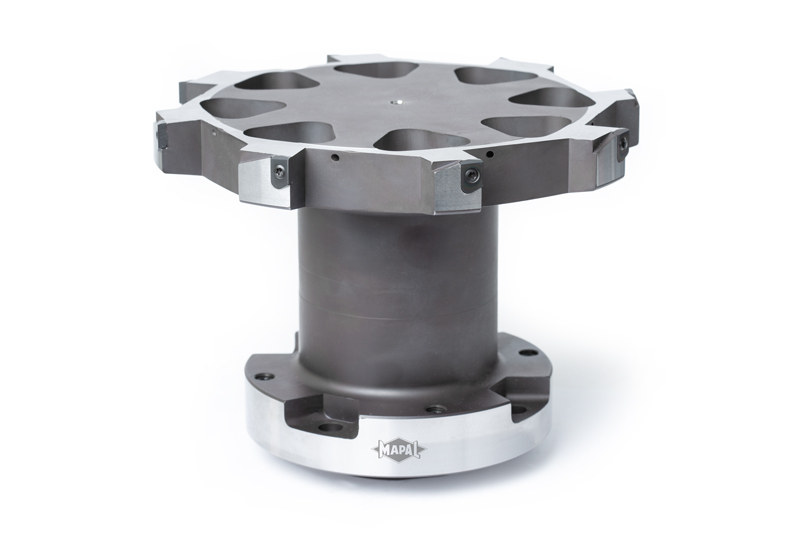
With the rise of electromobility, MAPAL was able to quickly offer a solution for machining the stator housing using the generic component approach. The focus of this process, which has been established for several years now, is high-precision manufacturing using fine boring tools. As the market matures, it is changing. Motors are now being built in larger quantities for vehicles in the mid-range segment. Accordingly, the industry’s desire for greater productivity is growing, too. Initially, it is less about the cutting data achieved than about the adjustment effort for the tools, which should be reduced for the production of larger series.
MAPAL has responded to the changing requirements and now offers a solution with HPR400 technology for finishing. The tools with PCD inserts are not to be set. Unlike the blades of a fine boring tool, they can simply be inserted and tightened with the correct torque. In addition to eliminating the need for setting, the new solution also boasts double the machining speeds, as eight inserts are now used instead of the previous four. Overall, the process delivers higher output with less effort, thus leading to a significant increase in productivity.
MAPAL’s model process specifies the use of guide pad technology for this machining step. And this is still justified, as the tolerances specified by premium manufacturers for some models cannot be achieved using other methods. Thin-walled components that are difficult to clamp also need a fine boring tool that exerts less cutting pressure.
Machining millions of rivet holes with maximum consistency
Final assembly in aircraft construction calls for productivity and high quality in equal measure. When the segments of a commercial aircraft are drilled with millions of bores for riveted connections, the continuous accuracy of the machining operations, which are mainly carried out using hand-held machines, is a challenge. Depending on the connection, the bores need chamfering, countersinking or simple deburring.
MAPAL’s spotfacing tools with microstop cages constitute a depth stop and ensure that the same result is achieved irrespective of the worker involved. The tool manufacturer handles the pre-configuration so that nothing else needs to be adjusted in manufacturing. With different cutting materials, the spotfacing tools with microstop cages are suitable for machining aluminium, CFRP or titanium. Customer-specific colour coding prevents tools from being mixed up and errors in the process. Optionally, dust extraction can be carried out directly on the tool.
In addition to rivet preparation, mirroring or metallising the area around bores on aircraft’s outer skin is another case for a spotfacing tool with microstop cage. In this process, paint is deliberately removed to ensure electrical conductivity between the parts and thus protection in the event of a lightning strike. The spotfacing tools with microstop cages demonstrate that very good effects can be achieved even with supposedly simple tools: Preventing errors in the process also contributes to higher productivity.
Automotive, aerospace or fluid power – smart solutions and close contact to the customer often open up huge potential for productivity. As a technology partner, MAPAL offers its customers comprehensive advice and support encompassing all technologies with the aim of achieving the required result and more.

Contact
Mathias Ostertag Public Relations mathias.ostertag@mapal.com Phone: +49 7361 585 3566


