28.10.2026
Kunststoffzerspanung für die Chipherstellung
NeoMill-Diamond-FlyCutter für saubere Oberflächen
Das Kerngeschäft der M-O-T Mikro- und Oberflächentechnik GmbH in Saarbrücken sind Anlagen für die Herstellung von Mikrochips. Auf dem Weg, möglichst viele der dafür benötigten Kunststoffteile selber zu fertigen, ist das Unternehmen mit dem Einsatz des MAPAL NeoMill-Diamond-FlyCutters ein gutes Stück vorangekommen.


Established in 2001, M-O-T Mikro- und Oberflächentechnik GmbH has been a part of the Woll Group since 2011. M-O-T complements the versatile range of the custom machine manufacturer by producing wet chemical process systems for the microsystem and semiconductor sectors. With a workforce of around 30 employees, this specialist company is fully integrated into the group, which is also evident with regard to its premises: M-O-T works out of three rooms in the middle of one of Woll’s manufacturing halls.
In this area, a number of things are different from the general production process, which is predominantly focused on metalworking. It is not permitted to wear outdoor shoes, and there is a slight yet constant atmosphere of overpressure. Although manufacturing does not take place in a cleanroom, it is carried out in a controlled environment with elevated cleanliness standards, as explained by production manager Mike Jakob. Contaminants that enter the space could change readings in the high-precision equipment and therefore jeopardise the process. When working at the customers’ premises, operations will subsequently take place in cleanrooms.

Plastics for various applications

The number of systems constructed has increased greatly in recent years. In 2021, the figure was five or six per year, but M-O-T now supplies 20 to 30 of them. Fluctuations depending on market conditions do exist, and these in turn are the result of developments in the global semiconductor market. Furthermore, the equipment is becoming more complex. Manufacturing initially relied on suppliers most of the time. The fact that M-O-T has been relying on in-house production since 2022 is also linked to quality issues experienced with parts supplied by external suppliers: there were repeated instances of leakages in finished systems.
The way in which M-O-T processes its plastic sheets may at first seem to be rather unusual: the machine originates from the modelmaking sector, the tool was developed for milling aluminium, and a disinfectant is used as the cooling lubricant. For the purposes of this system engineering firm in Saarbrücken, however, this non-traditional combination proved to be very effective.
NeoMill-Diamond-FlyCutter provides a solution after a year of research

The chosen machine was the T-Rex open-frame milling machine built by the manufacturer CNC-Step. The small SK30 connection is used as tool interface, while workpieces up to 1,000 x 1,000 mm in size can be clamped onto the vacuum table. It proved challenging to find a suitable tool for the intended machining operations where good surface quality was the primary concern. Jakob explained the situation: “We weren’t happy with the quality we were getting at the start. I spent a year looking for a suitable cutter head, but nobody was able to offer us a product that was completely suitable for the surface finish. It was while attending AMB 2024 in Stuttgart that I found what I was looking for with MAPAL, who had a milling cutter for our connection.”
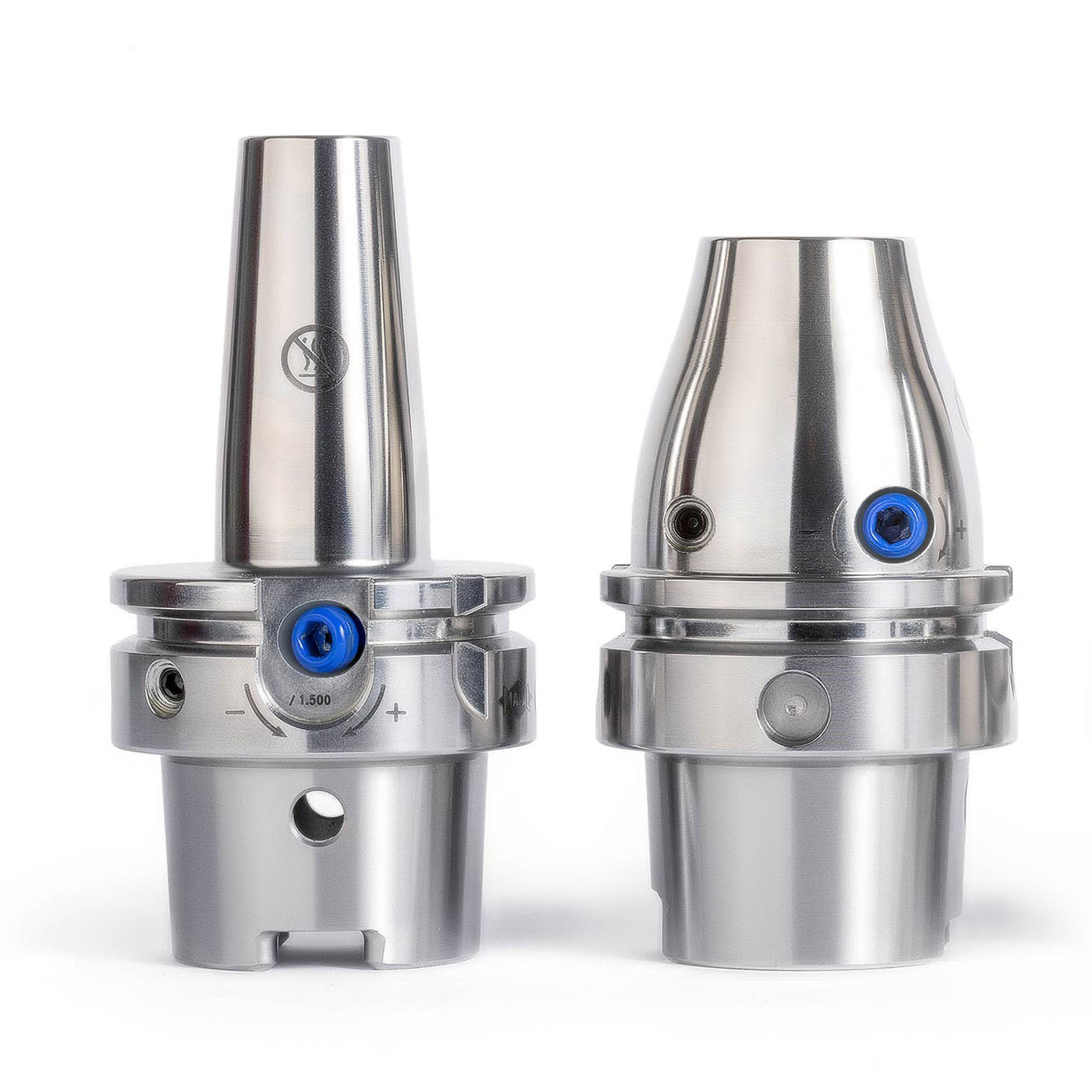
Together with Klaus-Dieter Leick, an application engineer at MAPAL, they determined the most feasible solution for the existing machine. They decided to go for a NeoMill-Diamond-FlyCutter with a milling head diameter of 63 mm. “We originally developed this tool for machining aluminium components in the electronics industry, where our aim was to produce a surface during face machining that was as close to perfection as possible”, explained Leander Bolz from MAPAL’s Component Management team. The Aalen-based tool manufacturer immediately felt confident that this would also work for plastics, especially since the tool had originally been designed for critical machine concepts such as small spindles and vacuum clamping.

The lightweight triple-edged milling cutter provided with a special cutting geometry lowers cutting pressure and removes chips from the machining zone relatively quickly. The low cutting pressure was already a core feature with regard to milling aluminium surfaces. By choosing the appropriate cutting material, MAPAL was able to adapt the tool to different materials.
M-O-T is very pleased with the NeoMill-Diamond-FlyCutter that has now been widely rolled out and has proven to be a genuine game-changer in surface machining. When the milling machine was purchased, the manufacturers only imagined it would be used to machine the doors of the enclosure. Over time, the company gradually expanded its in-house production capabilities and began manufacturing an increasing number of components itself. M-O-T now entirely manufactures the storage tanks for the necessary chemicals in-house and is also intending to manufacture the process cells in the future. Specialist components, such as Teflon process tanks, will continue to be manufactured externally. M-O-T uses the NeoMill-Diamond-FlyCutter for face milling the sheets. With regard to lateral machining and to finish contours, another tool from MAPAL, a PCD end milling cutter, is used.
Ongoing optimisation
Jakob’s department doesn’t yet believe that its goal has been fully met. Trials will be carried out with cooling lubricant to optimise surface quality and to better protect the tool. In particular, machining the rigid and brittle PVDF has at times caused wear to the PCD cutting edges on the NeoMill-Diamond-FlyCutter. However, M-O-T is severely limited in its choice of cooling lubricant. It is not possible to consider using oil since it may lead to the introduction of contaminants into the system that could, for example, affect the pH value or other process parameters. That is also why no metal chips are permitted in the M-O-T production area. Since it evaporates very quickly, isopropanol was chosen as the cooling lubricant, but the significant odour nuisance it causes means that it can only be used in a limited way on the machine.
It is also challenging to use plastics when it comes to cooling, as Robin Kollmann, who is responsible for milling operations at M-O-T, explains: “Plastics absorb less heat than aluminium. This means that the heat cannot be dissipated from the component rapidly enough. As a result, chips may fuse or clump together, which builds up more pressure and might potentially damage the cutting edge. The quality of the surface finish is also not as good as we would like it to be.” During the machining process, 0.3 mm is milled away per cut. Depending on the material and quality grading, the stock allowance is up to 1 mm.

Um bei der Bearbeitung nicht zu viel Hitze zu erzeugen, fährt M-O-T momentan mit einer Schnittgeschwindigkeit von 6.000 U/min und einem Vorschub von 1.200 mm/min. Damit bleiben die Fertiger deutlich unter den anfangs von MAPAL vorgeschlagenen Werten, die bereits niedriger angesetzt waren als für die Aluminiumbearbeitung. Um einschätzen zu können, welchen Einfluss die Isopropanol-Kühlung auf die Lebensdauer der Schneide hat, wurden noch nicht genügend Erfahrungen gesammelt. Parallel dazu hat M-O-T mit der Erprobung eines neuen Kühlmittels auf Wasserbasis begonnen. Im Rahmen der Versuche wollen die Fertiger auch höhere Schnittgeschwindigkeiten testen.
Inzwischen wurde der nächste Optimierungsschritt erfolgreich erprobt: M-O-T testete eine größere Variante des NeoMill-Diamond-FlyCutters mit 100 mm Fräskopfdurchmesser und hat das Werkzeug daraufhin bestellt. Der Wechsel ist in dem modularen System ohne größeren Aufwand möglich, da alle von MAPAL angebotenen Fräskopfdurchmesser von 63 bis 160 mm auf denselben Aufsteckdorn montiert werden. Damit wird deutlich, dass MAPAL die Anwendung nicht nur mit einem passenden Werkzeug unterstützt, sondern im kontinuierlichen Austausch mit dem Kunden weitere Ansätze zur Produktivitätssteigerung entwickelt.

Kontakt
Kathrin Rehor Public Relations Kathrin.Rehor@mapal.com Tel.: +49 7361 585 3342