
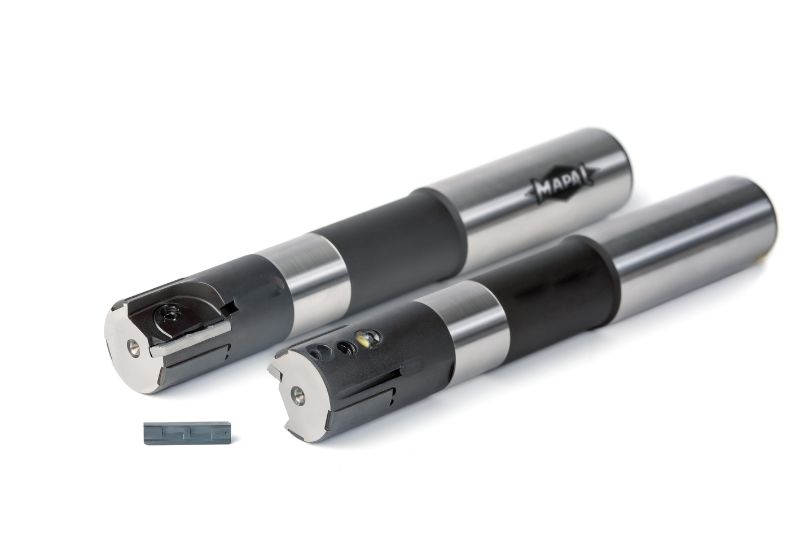
OptiMill®-Tro-Uni (2nd Gen.)
Trochoidal milling cutters for dynamic and reproducibly stable processes

More powerful machines, dynamic CAM strategies and increasing cost pressures are placing greater demands on modern trochoidal milling cutters. With the newly developed OptiMill-Tro-Uni, MAPAL addresses these challenges through the coordinated combination of optimised tool geometry and application-specific process design. The result is stable trochoidal milling processes, even when operating conditions are demanding.
In addition to a geometry designed for high stability, smooth running and reliable chip removal, MAPAL provides application-specific cutting data for three levels of dynamics. This gives users precise, application-specific starting values for the respective machining situation, tailored to the machine, clamping setup and process conditions.

The new concept has a direct impact on cost efficiency: High material removal rates, long tool life and stable machining help to reduce component costs. The OptiMill-Tro-Uni therefore offers a complete solution combining the tool with process expertise for cost-effective milling.
-
 1 / 4
1 / 4Repositioned chip breakers
- Shorter chips and improved chip removal
- Number of chip breakers aligned with the length variant
-
2 / 4
Optimised helix angles
Ideal balance between axial and radial forces -
3 / 4
Bigger core diameter
- Increasing from 4xD to 5xD
- Maximum tool stability
-
4 / 4
Cutting data for different dynamics and radial depths of cut
Application-specific starting values for a wide range of applications



/OptiMill-HPC-Pocket-Bearbeitungen-800x533-2-.png)


