01.10.2026
Precision solutions for comfort and safety
Wheel carriers and steering knuckles play a decisive role in a vehicle’s ride comfort and safety. Over recent years, these chassis components have become significantly more complex, evolving from passive structural parts into highly integrated, precision-engineered functional modules. With a wide variety of component designs in use throughout the industry, MAPAL provides efficient machining solutions tailored to every requirement as a technology partner for machining.

Depending on the axle and vehicle concept, wheel carriers and steering knuckles perform key functions in wheel guidance, force transmission and steering kinematics. As safety-critical components, they must withstand high wheel loads while meeting the most demanding mechanical and kinematic requirements. A wide range of component variants is used, depending on the manufacturer, steering system, vehicle class and installation space.
The materials used also vary considerably. Cast iron remains a cost-effective choice, particularly in lower vehicle segments where components are often required in high production volumes. MAPAL’s machining solutions are specifically designed to address the high abrasiveness of this material.

Steering knuckle becomes a functional module
These components have become considerably more sophisticated over time. While a control arm was previously bolted directly to the component, modern designs incorporate additional bearing arrangements. To ensure these bearings can be pressed in reliably, tight tolerances and high-quality surface finishes are required. Functional integration continues to advance. The steering knuckle now provides mounting points for the brake caliper, wheel hub, control arm and ABS system. As a functional module, it contributes to efficiency, driving dynamics and the integration of additional sensors, for example for autonomous driving functions.
As functional integration increases, so do the demands placed on machining solutions. The specified precision requirements and tight tolerance ranges contribute directly to drive comfort, noise reduction and bearing life. To achieve maximum accuracy and avoid errors caused by re-clamping, steering knuckles and wheel carriers are increasingly machined in a single setup and on multi-spindle machines. Depending on the component variant, annual production volumes can exceed 500,000 parts.
For the key machining operations, MAPAL offers multiple solutions tailored to different customer requirements. The following examples illustrate these solutions using aluminium steering knuckles. This approach allows the tooling specialist to address both the wide variety of designs used by vehicle manufacturers and differences in raw part quality and clamping conditions.
Focus on the main bearing bore
MAPAL has defined a range of tooling concepts for machining the main bearing bore. As a technology partner, the company is familiar with the specific requirements of its customers, selects the most suitable machining strategy and adapts it to local production conditions.
Depending on the casting process and component geometry, the bore may be completely cast closed, near-net-shape cast with a radial allowance of up to 4 mm, or, in the best-case scenario, pre-punched. As a result, high material removal rates are often required in the first machining step. MAPAL specialists use PCD circular milling tools to reduce the allowance and prepare the bore close to its final contour. Depending on the bore geometry, different process strategies are applied using milling tools, drill-milling tools or boring tools equipped with hook cutting edges for back boring operations. Tolerance requirements for the main bearing bore can be as demanding as IT6.
Where machining is carried out in two setups and clamping conditions are critical or unstable, MAPAL’s three-stage machining concept for aluminium steering knuckles begins with rough machining from both sides using a PCD milling tool. Two PCD boring tools then complete the finish machining of the diameter.
Where circular milling is possible, MAPAL offers a machining solution that enables higher cutting parameters. The OptiMill-Diamond-SPM milling cutter with brazed PCD cutting edges demonstrates its strengths in this application. Thanks to its highly positive cutting geometry and optimised chip spaces, cutting forces can be reduced by up to 15 per cent compared with conventional PCD milling cutters. The optimally integrated PCD cutting edges ensure high stability during machining. As an alternative using indexable inserts, MAPAL offers the NeoMill-Alu-QBig. Designed for high-speed machining, this high-volume aluminium milling cutter features a finely balanced tool body for optimum performance. In the final machining step, a complex PCD milling tool completes the entire contour of the main bearing bore.
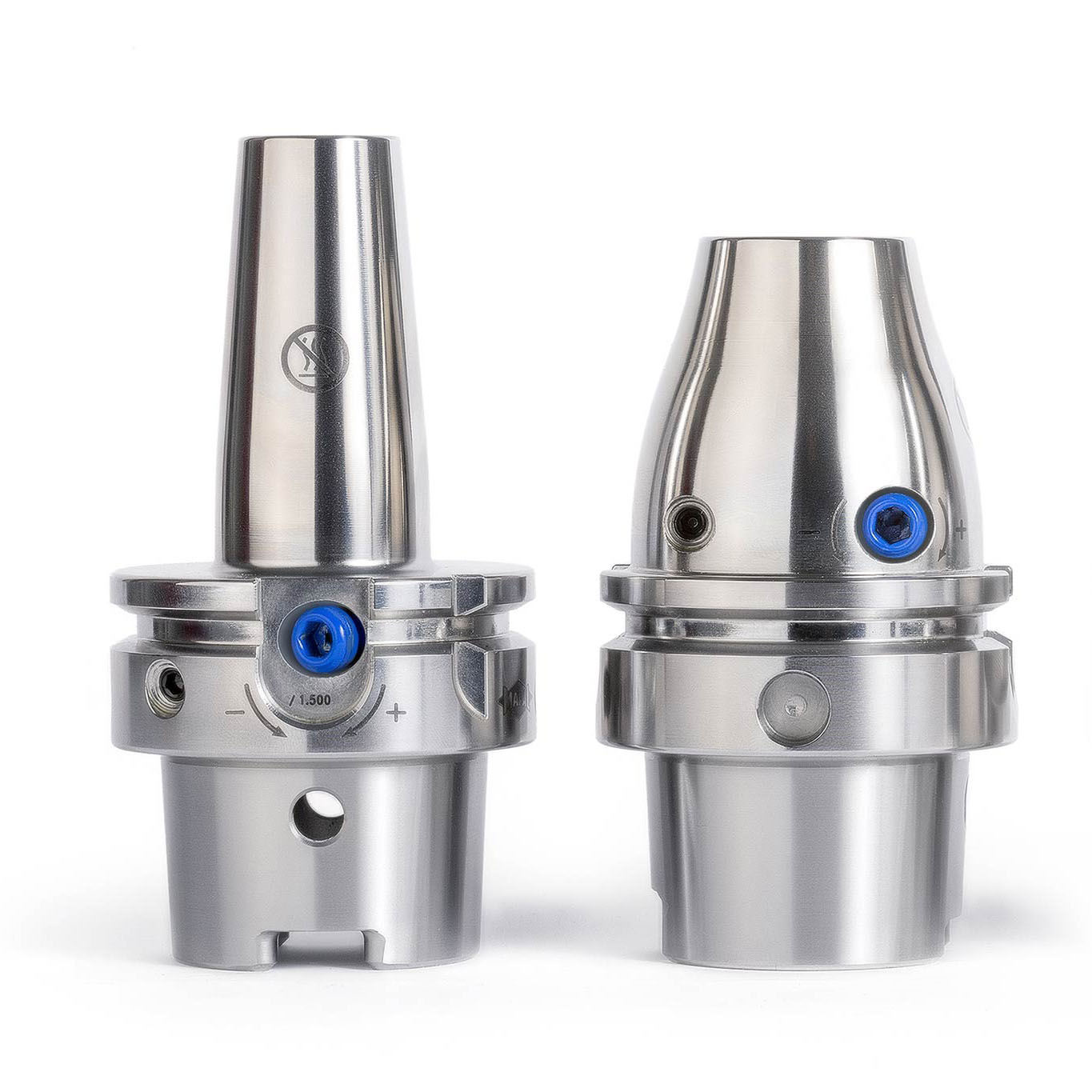
Where the tightest tolerances are required, MAPAL combines rough machining with the OptiMill-Diamond-SPM and semi-finishing using a multi-stage boring tool equipped with indexable inserts. The final machining operation is then carried out using a fine boring tool featuring the EasyAdjust-System. With this system, the back taper is already integrated into the cartridge that holds the insert, eliminating the need for a separate adjustment process. The diameter can still be adjusted with maximum sensitivity, ensuring highly precise machining results.
MAPAL’s portfolio for machining main bearing bores is complemented by one-shot solutions for pre-punched aluminium steering knuckles. PCD drill-milling and milling combination tools offer exceptionally high efficiency, particularly in applications with very stable clamping conditions that allow complete contour finishing by milling. Customers looking for an alternative to brazed PCD tools and requiring a solution without adjustment capability can opt for a tool with replaceable indexable inserts. The tangential milling cutter represents a sophisticated tooling concept that combines as many machining operations as possible in a single tool.
Keeping the wheel on track

Rough machining is performed from solid material, with the lugs of the control arm connection typically unsupported in the clamping fixture. It is therefore essential to keep cutting forces low during rough machining. MAPAL once again relies on the advantages of the OptiMill-Diamond-SPM, which mills the bores using helical interpolation without distorting the component. Because high feed rates and aggressive helical infeed strategies are often used, significant heat generation can occur in practice, particularly when minimum quantity lubrication (MQL) is applied. This can lead to built-up edges on the cutting tool. Any resulting bore deformation may only become visible after the finished component has cooled down. Drawing on extensive process expertise and a holistic view of the control arm connection, MAPAL works closely with customers to develop the optimum process, maximising productivity while avoiding such undesirable effects.
During finish machining, the fixture design may require tools with overhang lengths of up to 300 mm. With tools of this length, spindle engagement can create a tilting moment that prevents the set tool diameter from being transferred accurately to the component. To ensure compliance with demanding tolerance requirements under these conditions, MAPAL once again relies on the EasyAdjust-System. Thanks to its user-friendly cartridge design, the tool diameter can be adjusted with micrometre precision using a single adjustment screw. Diameter corrections can therefore be made quickly and efficiently, helping maintain process capability and quality requirements. For applications with slightly lower precision requirements, a brazed PCD boring tool is available as an alternative finishing solution.
Precision at the wheel hub interface

Another function-critical machining operation concerns the bolt-hole bore that creates the force-transmitting connection between the steering knuckle and the wheel hub. This feature demands high contour accuracy. During machining, the component must be swivelled into a specific position to allow tool access. Due to the angled machining position, significant deflection forces can occur, causing the PCD ball-nose milling cutter to vibrate. The consequences would be excessive machining noise, poor surface quality, inadequate form accuracy and reduced tool life.
MAPAL ensures reliable process performance even in these challenging machining conditions through optimised tool design. A precisely defined arrangement of cutting edges and cutting-edge positions, combined with tailored edge preparation, effectively suppresses vibration while maintaining high machining performance.
Turnkey expertise for demanding components

Contact
Kathrin Rehor Public Relations Kathrin.Rehor@mapal.com Phone: +49 7361 585 3342

